
Half of consumers now use AI-powered search, and is expected to influence $750 billion in revenue by 2028. McKinsey (2025)
AI is not just a search tool. It is a research tool. Customers using AI now understand brands more deeply than ever before. What used to take a person several searches and 20 minutes, AI handles in one prompt. Tools like ChatGPT can fan out into 20 related searches behind the scenes, synthesize the answers, and hand the user a single recommendation.
When someone asks ChatGPT, Perplexity, or Claude for the best personal trainer for elderly clients in Windsor, Ontario, the AI is pulling from Google’s existing index. It looks at what businesses exist in that niche, what people are saying about them, and what those businesses say about themselves. Then it picks one to recommend.
If your business is not part of that selection, you are losing to competitors who have already done the work to be cited. This article walks you through what generative engine optimization actually is, how AI decides who to recommend, the five strategies that get local businesses cited, how to track your visibility, and a starter framework you can follow.
Bookmark this. Come back to it as your guide.
So What Is AI Search or Generative Engine Optimization?
Generative engine optimization, or GEO, is the work of getting your business cited by AI tools like ChatGPT, Perplexity, Claude, and Google’s AI Overviews.The key word there is cited. AI does not give you a list of websites to choose from. It gives you a summary of what it found, and it credits the sources it used. AI is less of a search tool and more like an assistant that does the searching for you.
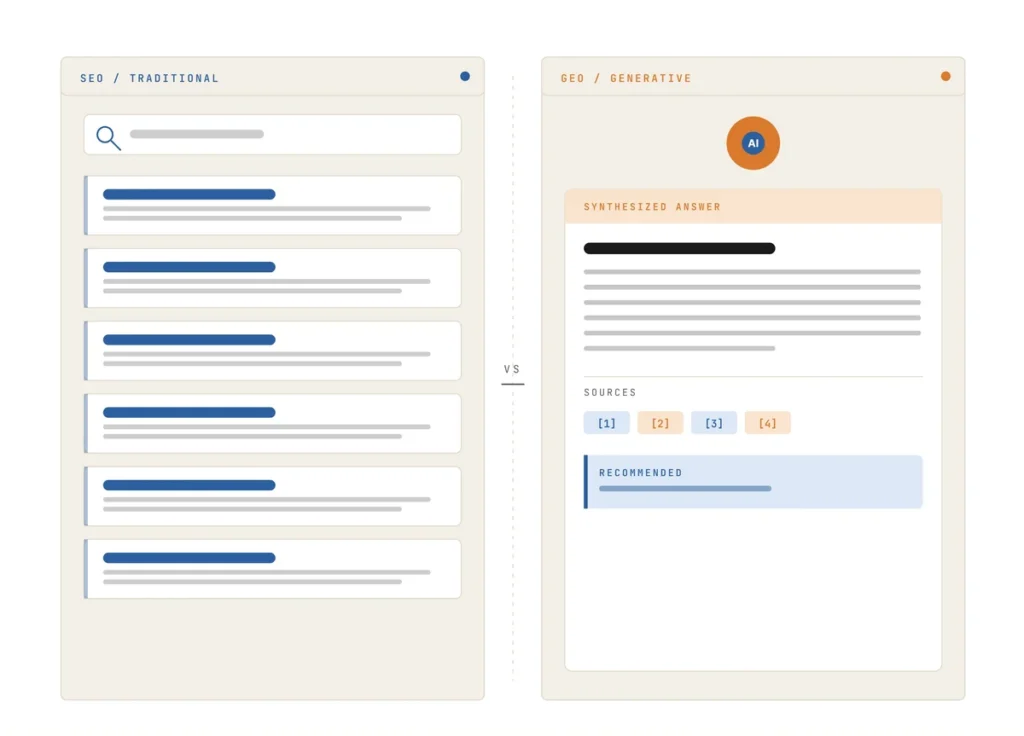
SEO vs GEO
You might ask, “if I have already done my SEO, will AI not just find me?”
The honest answer is yes and no. GEO does not replace SEO. It complements it. The difference is what each system rewards.
Traditional search engines like Google have always cared about keywords, backlinks, and domain authority. AI cares about something different. It cares what people are actually saying about your brand and what you are saying about yourself across the web. AI is a brand-relevance research tool.
Throughout this article, think of Google as a tool. Then think of AI as the assistant who uses that tool.
Why should you care as a local business?
Most local businesses are not large SaaS companies or e-commerce sites with hundreds of pages. That means relying on your website alone to be discovered is not enough.
For a local business, brand reputation matters more than ever. Reputation is what decides whether AI recommends you to the growing number of people who use it to find local services and answer real questions. Build your reputation, get cited by AI, attract real leads. It really is that simple.
How AI Chooses Who To Recommend
AI is not Google, and it is not trying to be. Where Google gives you a list of indexed websites that match your query, AI gives you the answer directly. The user does not have to hunt through ten links to find what they need. AI does that work for them and hands back a summary.
Because of this, AI does not prioritize keyword density, backlinks, or domain authority the way Google does. It looks at four things instead: content, structured data, brand reputation, and freshness.
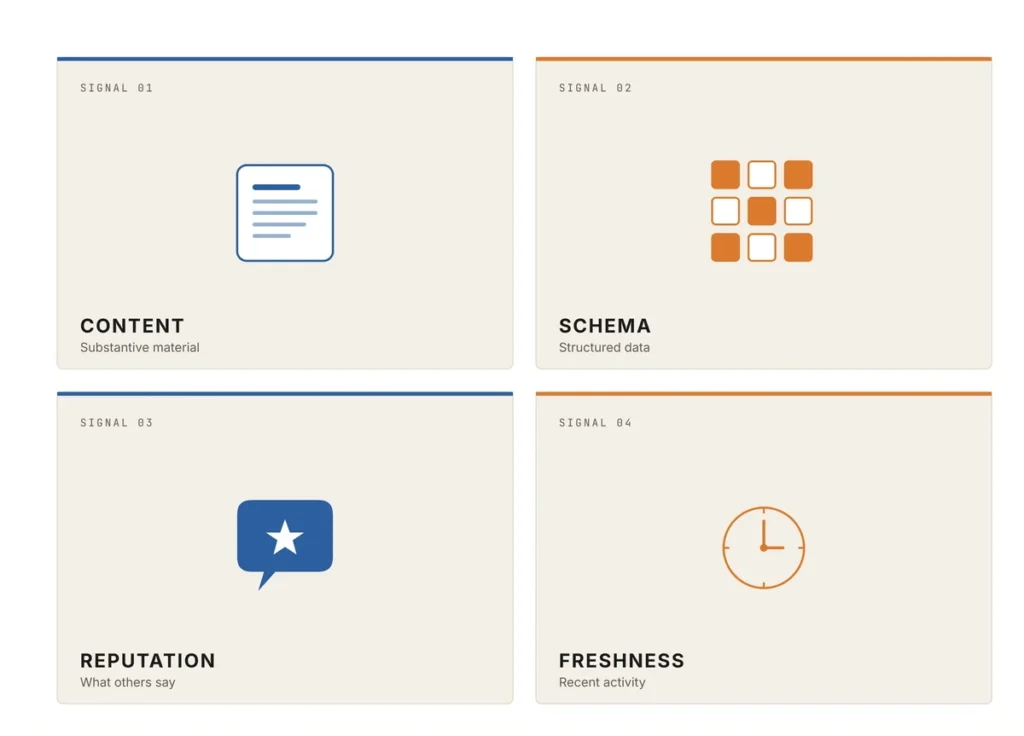
Content
Content is still king. A consistent stream of substantive content is more important than ever. That does not just mean publishing a blog post every week. It means expanding your presence across the platforms where your customers and your industry actually live.
This includes what other people say about your brand, which we will get to in a moment. The short version: AI cares about your voice, and your voice has to exist in more than one place.
Structured Data
Structured data, also called schema markup or JSON-LD, is a kind of universal language for search engines and now AI. It helps them understand exactly who you are and who you serve.
Schema is not magic. Most of your competitors who have done basic SEO already have it implemented. It has been around since the early days of search. Having it is an advantage. Not having it is a disadvantage. That is all.
Brand Reputation
This is where AI really separates itself from traditional search. AI is a research tool, and part of that research is reading what real people say about a topic across trusted sources.
If someone prompts ChatGPT with “who is the best personal trainer in Windsor, Ontario for working with elderly clients,” AI may find that a regional publication has covered an award-winning company in that niche. It may also find a Reddit thread where someone asked a similar question and another user recommended the same business. AI then uses what real people are saying to generate its answer.
What does this mean for you? PR is the new backlinks. Your reputation in your community matters. Generating real public attention for your business has never been more important.
“PR is the new backlinks”
Recency/Relevance
These two go together. AI does not have its own constantly-updated index. It pulls from existing indexed content and recent activity. Just like a person looking for the latest news on something, AI prefers fresher sources over outdated ones.
An article from 2023 with stale information will lose to a 2026 article with current data and clear answers. The same applies to your brand. A steady stream of recent reviews, recent local citations, and recent press coverage signals that your business is active and trusted right now.
5 Strategies To Show Up In AI Search
Here are the five specific strategies that will help you get cited by AI. None of them are radical. Some will overlap with your existing SEO work. The difference is how AI weighs each one when deciding who to cite.
These are listed in order of impact for local businesses.
1. Easy to understand service based content
What is it? Real, detailed content explaining what you do, how you do it, and who you serve. Not a one-page site with vague copy. This means proper service pages, location pages if you cover multiple areas, and content that answers the questions your customers actually ask.
Why does AI care? Generative engines build their answers from text. If your homepage has 400 words and that’s it, AI has nothing to cite. AI engines reward sites with something substantive to say. They are not looking for the most pages or the most words. They need enough material to determine what your business actually does and why someone should be sent your way.
How Can You Implement This? Look at your existing site honestly. Does a stranger have everything they need to understand your business? Do you have a services page that explains each offering, including realistic pricing where possible? Does your About page show real accolades, real testimonials, and real evidence that you are a trusted authority, or is it a vague founder story? If the answer to these is no, that is where to start.
Show your work. Link to articles about what you have done in your community. Include sections on awards, completed jobs, or recognition from credible sources. The simplest way to think about this: if you were in an interrogation room and a detective wanted to confirm you actually do what you claim, what would you show them? Build that on your site.
2. Mentions of your brand across the web
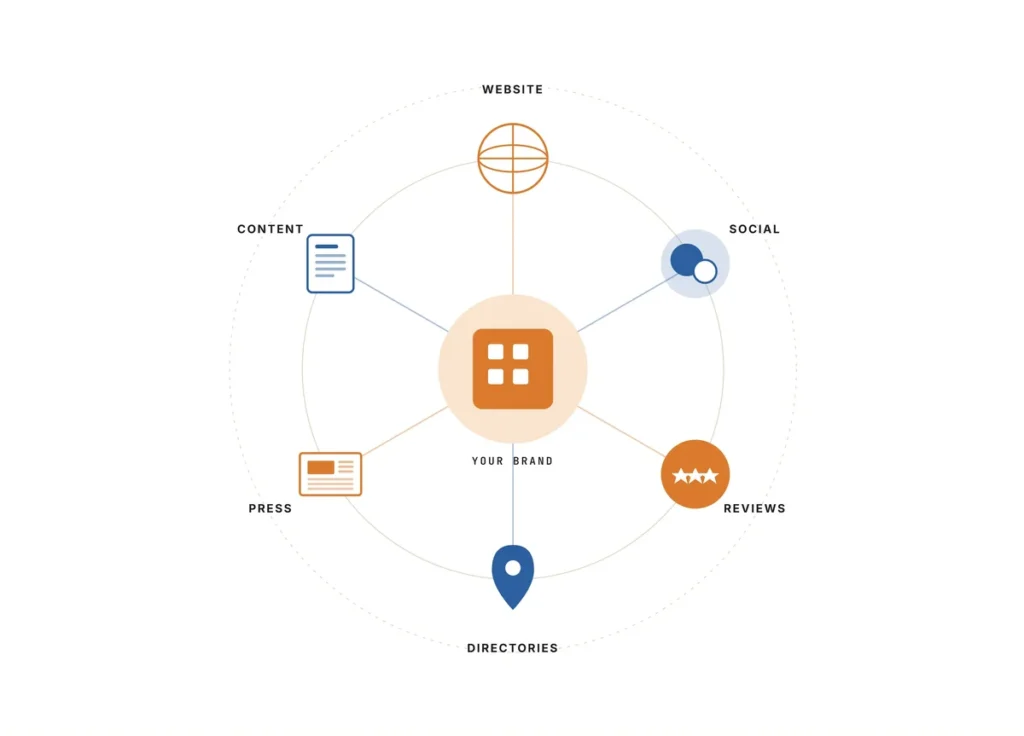
What is it? What people say about your business across third-party sites. Reddit, X, social media, business directories, regional publications, local news, blogs, and any other place where your brand can appear. Traditionally, this is called earned media.
Why does AI care? Just like Google still uses backlinks to gauge authority, generative engines use brand mentions in a similar way. The mention does not even need to include a direct link. It just needs to be there.
When ChatGPT decides which dental practices to recommend in Hamilton, it weighs which businesses are actually being talked about by trusted sources. A practice mentioned in a few regional publications and discussed in a local community forum has a real edge over a competitor with no public presence beyond their own website.
How Can You Implement This? Start with the basics. Local citation and directory work. Get listed in your local Chamber of Commerce, set up Yelp, optimize your Google Business Profile. Tools like Moz Local can help you find the right directories. If you have already been doing SEO, most of this is probably done.
Once the directories are sorted, focus on the harder, higher-leverage work. Build relationships with local journalists. Sponsor local events. Speak at industry meetups. Run your own event and invite local press. Get into Reddit threads in your niche and contribute real value, not promotion. Find every legitimate way to put your name in front of people in your community and your industry.
This is the biggest separator between you and your competitors. Most of them will not do it.
How long will this take you? This is ongoing work, not a one-time project. A reasonable starting commitment is 2-4 hours per week for the first few months. The compounding effect is real but slow. You are not just building trust with AI here. You are building trust with actual customers, which is what makes the work worth it either way.
3. Structured data and schema markup
What is it? Code added to your website that tells both search engines and AI exactly what your business does. It clarifies your services, your service area, your hours, and how to contact you. Common types include LocalBusiness schema, Service schema, FAQ schema, and Review schema.
Why does AI care? Generative engines will read your website prose, but structured data removes ambiguity. Without it, AI has to guess what your business does from context. With it, AI is told directly. This matters most for local-intent queries, where AI needs to know your service area, hours, and offerings to recommend you accurately.
To be clear: schema does not guarantee you will be cited. It just makes sure your content is easy for AI to understand.
How to implement this? This is the easiest strategy on the list. Most WordPress sites can implement schema through plugins like Rank Math or Yoast. The two schema types every local business should prioritize are LocalBusiness and Service. Together they tell AI where you are, who you serve, and what you offer.
How long will this take you? With a plugin, setup takes a few hours. Less if your site is small.
4. Answer real customer questions
What is it? Pages and articles in a question-and-answer format designed to address the specific things your customers ask. This includes FAQ sections on your service pages and full blog posts that answer single questions in depth. In SEO terms, this is informational-intent content.
Why does AI care? This is the core of how generative engines work. A user asks a question. The AI looks for content that has already answered that question well, then summarizes from those sources. By creating content that directly answers what people in your market are asking, you give AI something easy to cite.
In fact, this article is itself an answer to a question someone in your position likely typed into ChatGPT. cool eh?
How to implement this? Start with research. Use Google’s “People Also Ask” boxes for queries in your niche. Use AnswerThePublic to surface real questions. Browse relevant subreddits to find what your potential customers actually discuss. Pay attention to questions you get asked repeatedly by clients on calls or in emails.
Once you have a real list of questions, write the answers in a clear question-and-answer format. Use H2 or H3 headings phrased as the question. Give a direct, concise answer first. Then expand with detail. Do not bury the answer in setup paragraphs.
It will be tempting to use AI to generate these answers fast. Resist that. Generic AI-generated content is exactly what AI engines have started filtering out, and Google has been cracking down on it as well. Your unique perspective is what makes your content citable. Do not outsource the part that matters.
Start with five well-answered questions. Five great pages beat fifty thin ones.
How long will this take you? A high-quality answer takes 1-2 hours per question for an FAQ entry. A full blog post answering one question in depth takes 3-4 hours. A foundational FAQ section can be built in 5-10 hours total.
5. Reviews and review velocity
What is it? Customer reviews on your Google Business Profile, on directories like Yelp, and on any platform where your business is publicly rated. Review velocity refers to how often new reviews come in. Recent reviews matter more than the total count.
Why does AI care? Reviews work as both a sentiment signal and an authority signal. AI engines use them to understand what your business is actually known for, not just what you claim about yourself.
A practice with 80 recent reviews that specifically mention what you do well will outperform a practice with 200 outdated, vague reviews. Recency matters because it shows your business is alive and trusted right now. Specificity matters because it gives AI real material to summarize.
How to implement this? This is where in-person customer touchpoints matter most. When a customer finishes a service or visits your business, mention leaving a review. Make it easy with a scannable QR code that links directly to your Google Business Profile review page.
Encourage real, specific reviews. A customer who writes “great service” gives AI nothing. A customer who writes “Dr. Patel walked me through every step of the Invisalign process and answered every question” gives AI something concrete to cite. You can ask for specificity without being pushy. Something like “if you could mention what stood out about your visit, that helps other patients” works.
Respond to every review, good and bad. Your responses are content too, and AI reads them. Avoid buying reviews or pressuring customers. The best long-term play is treating customers like people you want a real relationship with.
How long will this take you? A few hours upfront if your Google Business Profile and Yelp are not already set up. Then 30-60 minutes per week on review responses, asking for reviews at the right moments, and refining the process. Ongoing work, like most of this list.
Putting the GEO Strategies Together
None of these five strategies are revolutionary. Some of them are already good business practices. The point is not to do one of them perfectly. It is to do all five consistently.
Picking one and ignoring the rest will not get you cited. Doing all five over time will. It really comes down to this: build your brand, and AI will trust you.
How do you know if Generative Engine Optimization is working?
Unlike Google, which gives you detailed keyword and ranking data through Search Console, AI does not hand you a clean dashboard. AI is not an index, so it does not track who is visiting your site or which queries surfaced you.
That makes measurement messier, but not impossible. Here is how to track your visibility.
Manually Test AI
The simplest method is also the most effective. Prompt ChatGPT, Claude, Perplexity, and Google AI Overviews with realistic local queries and see what they say.
Do not prompt AI the way you would search Google. People do not use AI like a search engine. They ask full questions. If you run a pizza place in Leamington that is known for shawarma-style pizza, do not type “pizza Leamington.” Type something like, “are there any pizza places in Leamington that make pizzas with shawarma?”
The best way to test is to think through your customer journey. Run prompts at each stage:
- Informational: “What is the best style of pizza for a family dinner?”
- Comparison: “Who are the best pizza places in Leamington?”
- Transactional: “Where can I order pizza in Leamington tonight?”
Test from multiple angles. Document every response.
Document Results and Brand Reputation
After your AI testing, track what AI is currently saying about your business, if anything. Do the same for what real people are saying. Search your business name on Google, Reddit, and review platforms. Note the patterns.
Together, this gives you a full picture of where your brand reputation actually stands and how it shows up in AI responses.
Track changes month by month
Did I mention that this is a slow process? Set up a Google Doc or spreadsheet that logs your tracking on a monthly basis. Each month, note:
- Which AI engines mention you
- What they say
- Any new mentions or reviews you have earned
- What work you put in that month
Over time, this shows you what is working and what is not worth the effort. Generative engine optimization is the same as SEO in this respect. Small wins compound. Even a single AI Overview mentioning your business name is a real signal that the work is paying off.
Should you buy tools to track this?
Not at this stage. As a small local business, you do not need a $200 a month AI visibility tracker.
These tools exist, and they are useful at scale. They are also expensive, often locked behind annual subscriptions, and not always more accurate than what you can see by hand. Your priority right now is building the brand presence that gets you cited in the first place. The early wins will be obvious enough to spot without paid software.
What does NOT work for GEO
Just like SEO, generative engine optimization has already attracted shortcuts and snake oil. Here are four things that do not work, either because they are ineffective or because they will actively damage your standing with both Google and AI.
AI Generated Content
Do not generate content with AI and then cram keywords into it. Google has been cracking down on scaled AI content, and AI engines themselves are starting to filter it out. The whole system is moving toward rewarding original human perspective, not regurgitated text.
The simplest rule: write for people first. Then make sure Google and AI can find it.
Massive Backlink Building
Backlinks still matter for Google as an off-page ranking signal. They are not the same lever for AI, since generative engines rely on Google’s index rather than building their own.
Avoid spammy backlink services, bulk link buying, and any vendor selling “guaranteed first-page links.” You risk a Google penalty, you waste money, and you give your information to operators who often turn out to be scams. Build natural backlinks the slow way through real content and real outreach.
Schema is not magic
If you have ever talked to an SEO professional, you have probably heard schema mentioned like it is a secret weapon. Some agencies sell it as a magic fix that gets you to rank.
It is not. Schema is the least impactful of the five strategies in this article. It helps AI and search engines understand what your business is, but it cannot make weak content rank or generate citations on its own. Treat it as a clarity tool, not a growth lever.
Paying for AI listing services
If you have read this far, you have probably noticed a pattern. Generative engine optimization is not complicated, and it is not something you can buy as a one-time service. Most of the work overlaps with real SEO and real PR.
Most companies selling pure AI listing services are scams or are simply repackaging basic citation work at a markup. A legitimate local SEO professional will fold AI optimization into a broader strategy, not bolt it on as an extra fee. Be skeptical of anyone guaranteeing AI citations or charging separately for them.
How Long Does GEO Take
There is no exact answer, but here are honest estimates.
In the first 1-3 months, you should start seeing some visibility in AI engines, especially if you have already built a decent brand foundation. If you have been around for a while and done basic SEO, early visibility is realistic.
It typically takes 6-12 months to see a regular citation pattern. This is when AI consistently surfaces your business for relevant local prompts.
This is not faster than SEO. It runs in parallel to it. GEO is not a separate project. It is an extension of the same long-term work. As long as you focus on authority, content quality, and trust, you are building the foundation that gets you cited in both search results and AI responses.
A GEO Starter Framework for Local Businesses
This plan breaks into four phases: foundation, content, authority, and monitoring. Combined with the five strategies above, this framework gives you a real shot at being cited by AI.
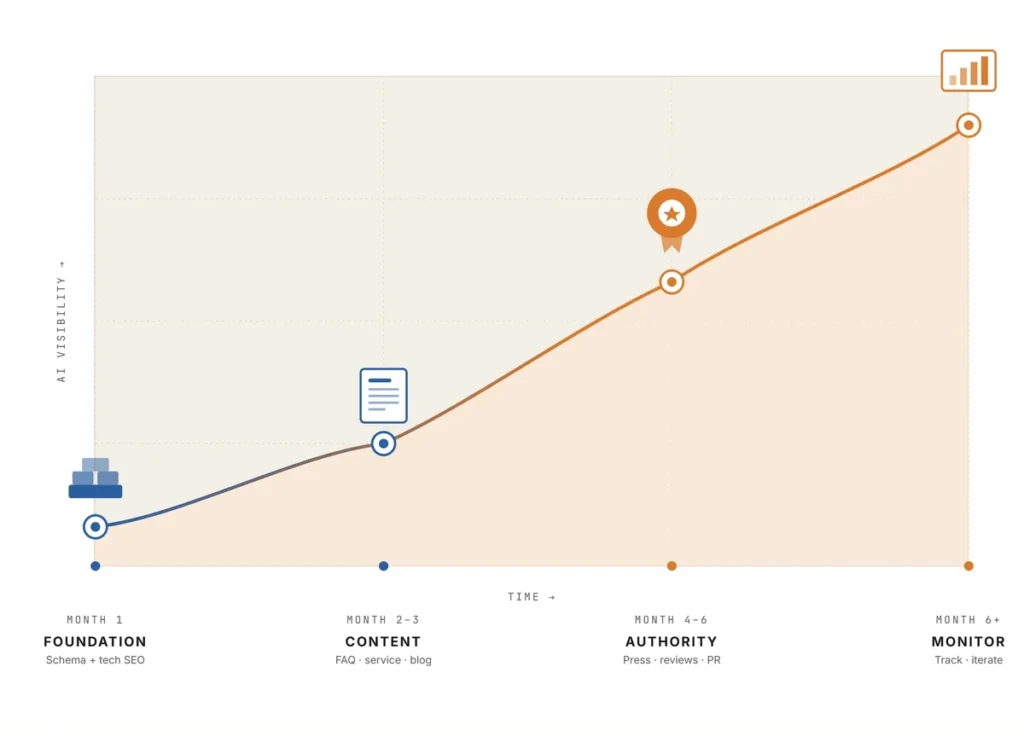
Phase 1: Foundation (Month 1)
Most of this is on-page work. Implement structured data on the relevant pages. Make sure each page is understandable to both users and AI. Audit your existing SEO for gaps.
Check your technical fundamentals. Submit a sitemap to Google Search Console. Identify pages that are crawled but not indexed. Fix any obvious issues with site speed, mobile usability, or broken links.
This is also the right time to honestly assess whether expanding into GEO is worth your effort right now. If your fundamentals are weak, fix those first.
Phase 2: Content (Month 2-3)
With your technical base in place and structured data set, start creating fresh content. Build a real FAQ section. Add a blog with a clear content strategy. Make sure your website content aligns with what you put out on social media.
Write for humans first, AI second. That means understanding where your customer is in their journey and answering the actual questions they are asking, not the questions you wish they were asking.
Phase 3: Authority (Month 4-6)
Once your content foundation is in place, shift focus to building your brand presence across the web. Get cited in local news. Get into relevant subreddits and contribute real value. Find every legitimate way to put your brand in front of your community, both online and offline.
This is where modern SEO and GEO start to blur with PR. Stop thinking like a technical SEO and start thinking like someone running a small public relations effort. Become more than a name. Become an entity.
Phase 4: Monitor and Adjust (Month 6+)
By this point, you should have been documenting your AI visibility and the work you put in each month. Now is when you analyze the data.
Look at what is visibly working and find ways to lean into it. Identify what is not producing returns and stop spending time there. Generative engine optimization is the same as SEO in this respect. Compounding small wins beats chasing every new tactic.
The Truth About This Framework
This is not a one-and-done job. Finishing the content phase does not mean you stop creating content. Throughout the entire framework, you should be adding fresh material that increases your chances of being cited.
Treat SEO and GEO like a fire. You feed it to keep it burning. Stop feeding it, and it goes out.
So What’s The Difference Between GEO and SEO
About 80% of GEO work is solid SEO fundamentals. If you have a strong SEO strategy, you have already laid most of the groundwork for GEO.
The 20% difference is where AI cares about things your competition is probably ignoring. That means quality content for every stage of the customer journey, real brand reputation across the web, and proper structured data.
The deeper shift is this: AI and modern Google care more about what is being said about you and what you say about yourself than about keyword density or backlink count. Yes, traditional SEO factors still matter. But in an era where keyword tactics are easy to manipulate and AI-generated content has flooded the web, search engines and generative engines are pushing real, fresh content backed by both authoritative sources and regular people.
The move here is not to rebuild your strategy. It is to adjust your priorities.
Start by being honest with yourself. Take a real look at your site’s content. Investigate what people say about your business online. If you are not even ranking for your target keywords on Google yet, you have bigger problems to solve before worrying about AI. If you are ready to layer GEO on top of solid SEO, the next section gives you a framework to follow.
Feed the GEO flame!
Generative engine optimization is not optional anymore. The good news is that it is not hard either. If you have already been doing real local SEO, you are most of the way there.
The work is consistent, real, and ongoing. The local businesses that own AI search visibility in 2026 will be the same ones that own the search results in 2030.
If you want an honest assessment of what to fix first for your own business, you can reach me at [email protected] or book a free 15 minute call.

Samuel Smusiak is a freelance local SEO and content strategist based in Windsor, Ontario, helping local service businesses show up in Google, Maps, and AI search. Reach out at [email protected].