
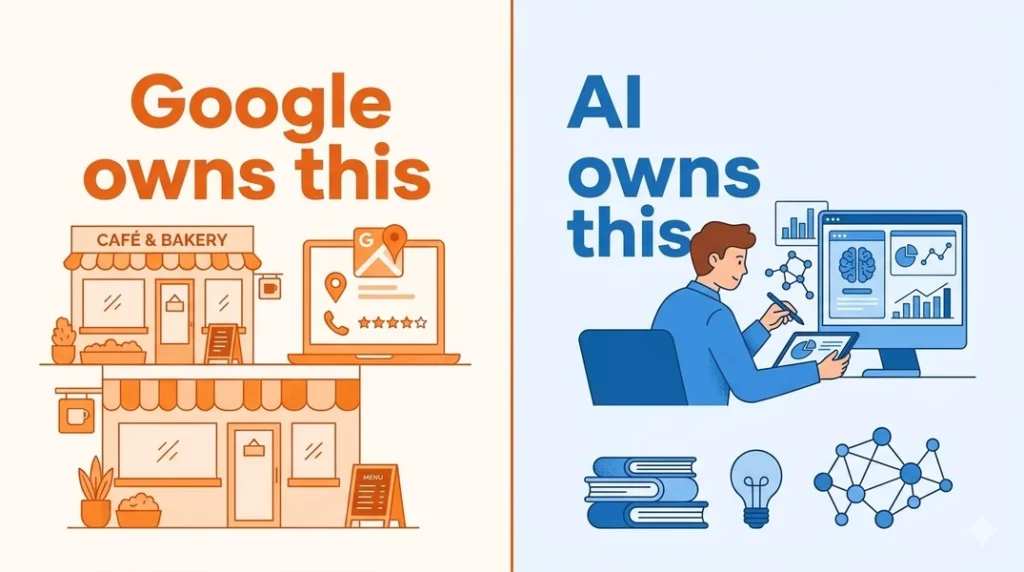
In 2025, search officially stopped being one thing and it became two.
One half is local and transactional, these are high purchase intent crowds, the “I need this now” half. That half is still controlled by the traditional search pages and is Google’s domain. It’s informational and research based queries that have been claimed by AI.
A 2025 study from Andy Crestodina, Orbit Media, and QuestionPro found that 26% of “find a company” queries now happen on AI tools. This shows a structural shift in how people search.
In this post I will be running through AI search optimization for local businesses. Specifically, what to do when a quarter of your traffic is migrating to AI while the rest hold on to using Google as their native search tool. The answer is simple, don’t pick a side and build for both in one strategy.
The Split Nobody’s Talking About
Most writing about AI and Google are asking “Is AI replacing Google?” The truth is the question is outdated and the real question is how do we adapt to an already changing search ecosystem that is splitting in two.
Transactional and local intent still belong to Google.
Booking a plumber, finding a coffee shop, and checking store hours. This is where Google thrives and continues to do so.
Informational and research intent is moving to AI
Questions like how does a heat pump work, what should I ask a contractor, what are the steps to file an LLC are where AI dominates. People are relying on AI for quick step-by-step instructions
The Crestodina/QuestionPro study surveyed 1,040 US respondents across all 50 states. The study was based on self reported behaviour and so treat this as a sign of the trends. The direction is clear however and that is AI overviews and chatbots have already taken over the Informational landscape.
The split isn’t perfectly clean as some queries reach a middle ground but none-the-less the data changes the way you should think about your website.
Why Google Still Owns Local Search
Google holds 79% of US search market share including AI search with Google dominating 95.5% of the search engine market, according to Statista’s tracking data. Even in the AI era, these numbers haven’t moved.
Local search is a major reason for this. When someone wants a quick bite to eat, they don’t open ChatGPT and read a 400-word essay. They go to Google, see three options with real reviews, stars and hours, and they pick one. That interaction, the high intent interaction, is what still leads to real sales for local businesses and is what google has spent twenty years optimizing for.
Google Business Profile, Google Maps, reviews, hours, directions, “open now” filters, photos, and booking integrations make the perfect local search ecosystem. AI search doesn’t have that infrastructure, it can describe a restaurant and maybe a brief side of what people are saying. It can’t tell you the table is available at 7:15pm.
For local businesses, this high intent area is the most defensible part of your funnel. It’s the most likely to convert because someone searching “emergency electrician near me” is worth more than someone reading “how does residential wiring work.” Google owns transactional intent.
Why AI Owns Research and How-To-Queries
The Crestodina study identified step-by-step instructions as the most competitive category between Google and AI tools. Long, multi-part, “explain it to me” questions are what large language models do well. They are also what a list of ten blue links do badly.
A Seer Interactive analysis found that comparison and question queries trigger AIO on more than 85% of informational searches. Google themselves are cutting into the informational pie with AI overviews and this makes sense. When people do research it’s a lot easier to have a summary and outline generated for you rather than having to dig through multiple websites.
Statista reports that 13 million US adults now use generative AI as their primary search tool. The fact is people are growing to rely on AI for complex informational questions because AI can simply do it better. It can answer it better and speak to the user’s experience. Traditional Google search struggles to actually provide incredibly specific answers that are designed to help a single user versus multiple people with the same problem.
For local businesses that had a strategy like “rank blog posts on informational keywords to fill the top of the funnel,” that strategy has quickly become outdated. Clicks are now absorbed by AI overviews and chat bots that simply answer the query better.
Three Shifts for AI Search Optimization for Local Businesses
This is what the split means in practice. Three shifts, in order of leverage.
Shift 1: Transactional Pages Are Your Most Valuable Real Estate Now
When AI controls informational clicks, the traffic on your site is more bottom-of-funnel than it used to be. Service pages, location pages, “book now” pages, pricing pages. These are the pages that convert, and they’re doing a bigger share of the work now.
Audit them. Are they written for humans? Do they answer the question someone has the moment they’re about to call? Are conversion paths obvious? This is not a secondary strategy. Focus on your money pages.
Shift 2: Your Google Business Profile Matters More, Not Less
Your GBP is the one asset AI search cannot fully replace. It’s tied to verified location data, live hours, real reviews, and the Maps ecosystem. It can summarize your website and prepare overall summaries but not direct information. Treat your GBP like a primary channel and not just a set up task. Keep your photos updated, respond to reviews, and use posts. If you are a local business still treating GBP as a set-and-forget task, you are leaving money on the table.
Shift 3: AI Optimization Is the New Top of Funnel
You have to move your blog posts that capture informational searches with the traffic.
You aren’t aiming to rank on a results page anymore. You want to get cited. That means structured content, clear claims, real expertise, citations the AI can verify, and pages built so a model can pull a clean answer out of them. Be the source someone trusts before they call.
Informational and commercial content should be treated as a brand trust builder.
What To Do This Week
Local businesses don’t need a quarter-long project to optimize for this trend.
- Optimize transactional pages first. These are your primary conversion pages and the largest revenue builders.
- Treat your Google Business Profile as your highest-leverage local asset. Keep it updated like a channel and not a directory listing.
- Blend traditional SEO and AI search optimization for local businesses into one strategy. The split is real. Your plan shouldn’t be.
Local businesses that win in 2026 won’t be the ones who pick AI over Google or Google over AI. It’s going to be the ones who understand which half of search owns which type of query.
If Google still owns your local visibility, AI search is the half you’re probably not optimizing for yet. Here’s the practical playbook on how to get cited by AI search. Generative Engine Optimization: How Local Businesses Get Cited by AI Search.

Samuel Smusiak is a freelance local SEO and content strategist based in Windsor, Ontario, helping local service businesses show up in Google, Maps, and AI search. Reach out at [email protected].